Drawing on years of experience in lateral flow backed by Good Manufacturing Practices (GMP) methodologies, Mark Jones, COO of Abingdon Health shares key insights on the transition from successful immunoassay development to commercial rapid test manufacturing. This represents one of the most critical – and most challenging – phases in bringing a diagnostic product to market… Done well, lateral flow technology transfer accelerates your path to commercialisation while maintaining the performance characteristics that made your assay successful in development. Done poorly, it becomes an expensive bottleneck that can add months to timelines and require costly redesigns.
We’ve supported dozens of tech transfer projects, from companies moving internal development to manufacturing for the first time to established organisations switching lateral flow CDMO partners, transitioning between facilities or scaling up production. While every project has unique technical requirements, certain approaches consistently deliver smooth transitions and minimise timeline risks.
Understanding Technology Transfer Complexity
Lateral flow tech transfer involves more than simply moving a proven process from one location to another. Several inherent technical factors create complexity that requires systematic planning and execution.
Scale-Related Changes in Process Behaviour
Process behaviours that remain constant at research scale can shift when moving to commercial volumes. Reagent preparation in 50mL quantities operates under different physical dynamics than 5L batches – mixing patterns, temperature distributions, and reaction kinetics all change with volume. Membrane coating across a few development strips versus production-scale rolls introduces new variables in uniformity and edge effects.
These scale-dependent variations aren’t deficiencies in the original lateral flow assay development – they’re fundamental physics and chemistry that become apparent when transitioning from benchtop to industrial scale. Successful technology transfers anticipate these shifts and build systematic verification into the process rather than treating unexpected variations as surprises requiring extensive troubleshooting.
Equipment Variations Between Facilities
Even when development and manufacturing sites use functionally similar equipment, differences in vendors, models, calibration approaches, and operational parameters can affect process outcomes. A scaled up process for dispensing reagents onto a nitrocellulose membrane will typically use drying processes different to bench scale methodologies meaning the drying process and associated assay stability needs to be determined and shown to be equivalent. Bench top lamination can be very different to a scaled process, specifically the pressures involved and the resulting tensions of the materials laminated onto the backing card that can lead to variation in card integrity and conjugate release characteristics.
These equipment-related differences are normal and expected. The key is recognising that “similar equipment” doesn’t mean “identical behaviour” and building appropriate verification and qualification steps to understand and accommodate equipment-specific characteristics.
The Documentation Challenge
Development work appropriately focuses on optimising assay performance and demonstrating technical feasibility. The level of process documentation that supports effective development doesn’t always match the detail needed for manufacturing execution by teams who weren’t involved in original development.
Details that are implicit knowledge for development teams – like the specific characteristics that distinguish acceptable versus marginal reagent lots, the subtle visual cues that indicate optimal coating conditions, or the rationale behind specific process timing – may not be captured in written protocols. This isn’t a documentation failure; it’s the natural difference between documentation that supports iterative development versus documentation that enables independent manufacturing execution.
Bridging this gap requires structured knowledge transfer that goes beyond document handoff to include direct collaboration between development and manufacturing teams.
Building Foundations for Successful Technology Transfer
The smoothest tech transfers share common characteristics in how they’re planned and executed, with many critical decisions made well before formal transfer begins.
Designing with Manufacturing in Mind
Development processes that consider manufacturing constraints from early stages create natural advantages during tech transfer. This doesn’t limit development creativity – it channels innovation toward solutions that can scale efficiently to commercial production.
For example, selecting antibodies that are commercially available from multiple qualified suppliers provides supply chain resilience during scale-up. Designing reagent preparation protocols compatible with standard industrial mixing equipment avoids the need for custom apparatus. Choosing membrane materials and process conditions that accommodate normal manufacturing variation reduces validation complexity.
These considerations integrate manufacturing realities into development decision-making without compromising assay performance requirements.
Creating Transfer-Ready Documentation
While development doesn’t require manufacturing-level documentation detail, capturing certain process information during lateral flow assay development significantly streamlines eventual transfer. This includes:
- Detailed reagent specifications beyond catalogue numbers – lot characteristics, storage sensitivities, shelf life observations
- Comprehensive process parameters – established timing boundaries, temperatures, equipment settings, environmental conditions
- Process robustness understanding – which parameters critically affect performance versus which tolerate variation
- Problem-solving history – challenges encountered during development and successful resolution approaches
This information doesn’t need formal manufacturing procedure formatting during development, but sufficient detail enables lateral flow manufacturing teams to understand not just what to do but why it matters.
Early Supplier and Material Qualification
Materials that work well during development sometimes create challenges during manufacturing scale-up – not because of quality issues but due to factors like availability in commercial quantities, cost, lot-to-lot consistency at production scale, or lead time compatibility with manufacturing schedules.
Identifying these potential constraints during development and establishing qualified suppliers early prevents transfer delays. For materials with limited sources, qualifying alternative suppliers before transfer begins provides supply security. For standard materials, confirming suppliers can meet manufacturing volume and consistency requirements avoids unexpected bottlenecks.
The Tech Transfer Process: Systematic Phases
Effective tech transfers follow a structured progression through distinct phases, each building on previous work and validating readiness for the next stage.
Phase 1: Knowledge Transfer and Planning
Formal tech transfer begins with comprehensive knowledge sharing between development and manufacturing teams. This goes beyond document review to include:
- Detailed discussion of development history – approaches tested, learnings from challenges, critical success factors
- Equipment and facility familiarization – development team understands manufacturing capabilities, manufacturing team learns development context
- Hands-on process demonstration – development scientists show manufacturing teams critical techniques and quality indicators
- Gap identification and planning – systematic assessment of what additional work or materials are needed
This collaborative phase establishes shared understanding and identifies potential issues while they’re still easily addressable. Time invested here consistently reduces troubleshooting time later.
Phase 2: Manufacturing Verification
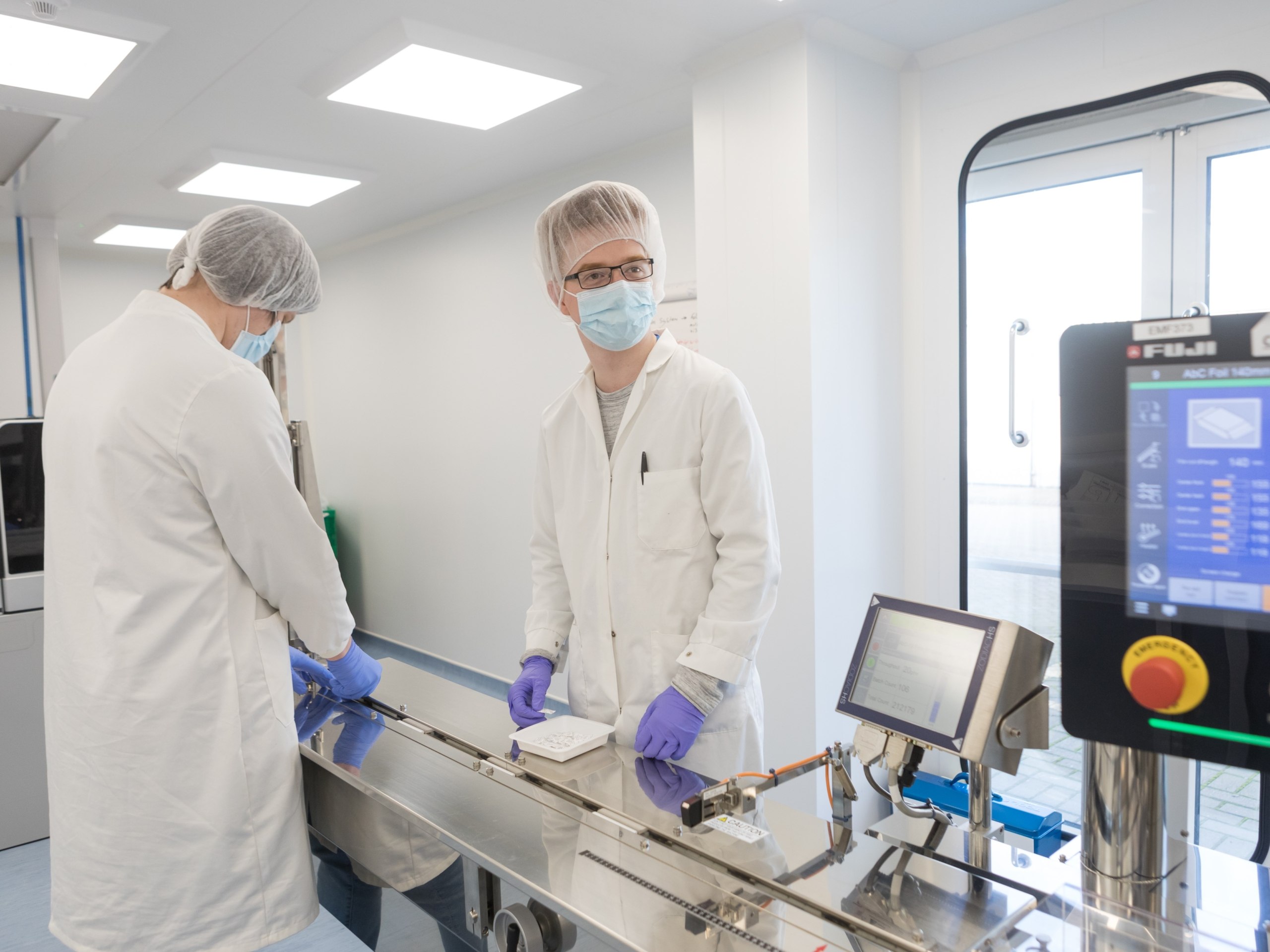
Before committing to formal validation, manufacturing teams produce verification batches to confirm they can achieve development-level performance using production equipment and conditions. These runs serve as systematic experiments to understand how manufacturing environment and equipment affect the process.
Verification activities might include testing ranges of coating speeds to identify optimal parameters for manufacturing equipment, evaluating how temperature profile differences affect performance, or optimising drying cycles that accommodate production scheduling needs.
Adequate investment in verification – typically 4-6 weeks – enables faster validation because the process being validated has already demonstrated manufacturability. Insufficient verification often leads to validation cycle failures that extend overall timelines significantly.
Phase 3: Process Validation & Manufacturing Readiness
With verified manufacturing processes, formal process validation confirms that production reliably delivers product meeting all specifications. Process validation scope depends on regulatory requirements but typically includes the production and testing of three independent batches to ensure the manufacturing process is stable, reproducible and robust.
This final phase also ensures all supporting systems are operational before commercial launch: complete supply chain establishment, quality control procedures fully implemented, manufacturing documentation finalised and approved, and comprehensive personnel training completed.
Most lateral flow immunoassay product development projects require minimum 8-12 weeks for process validation and manufacturing readiness (excluding the standard product verification and validation activities). This is the final critical stage in the transfer process and worthy of a blog of its own. Watch this space!
Common Challenges and Practical Solutions
Even well-planned transfers encounter challenges. Recognising common patterns and having systematic approaches to address them keeps projects moving forward.
Challenge: Performance Differences Between Sites
When initial manufacturing batches don’t fully match development performance, systematic investigation typically identifies addressable root causes. Start by confirming materials are truly equivalent – even supposedly identical reagents from different lots can show subtle variations. Verify equipment operates within development-established parameter ranges, acknowledging that “similar” settings may need site-specific optimisation.
If materials and settings align but performance differs, environmental factors like humidity, temperature fluctuations, or process timing variations often explain the gap. Methodical testing identifies which variables need tighter control or specification adjustment.
Challenge: Information Gaps During Transfer
When manufacturing teams need process details beyond available documentation, the most efficient path forward combines development team consultation with targeted verification work. Development scientists can often provide missing context based on experience, which manufacturing teams then verify through focused experiments rather than comprehensive redevelopment.
If original development teams aren’t available – common when acquiring technology or licensing from external sources – systematic process characterization becomes necessary. Planning for this scenario during transfer scheduling prevents timeline surprises.
Challenge: Timeline Pressure Creating Risk
When transfers extend beyond initial projections, pressure builds to accelerate validation or reduce verification scope to recover schedule. This approach consistently backfires. Incomplete validation leads to batch failures during production, creating larger delays and quality issues than investing adequate time upfront would have.
Maintain appropriate urgency on efficient execution while preserving validation rigor. Speed comes from systematic planning and experienced execution, not from shortcuts that create downstream problems.
Setting Realistic Expectations
Understanding typical tech transfer timelines helps companies plan appropriately and make informed decisions about when to initiate transfer relative to commercial launch requirements. Timescales will be dependent on the complexity of the process. For example, when transfers involve significant equipment differences, incomplete documentation, or substantial scale changes then these will impact the transfer timelines. Ultimately, companies that plan realistic schedules make better strategic decisions about launch timing and resource allocation.
Tech Transfer as Competitive Advantage
Organizations that consistently execute smooth tech transfers treat the capability as a strategic competency. They invest in appropriate documentation practices during development, allocate realistic timelines and resources for transfer, and select lateral flow CDMO manufacturing partners with demonstrated expertise in similar transitions.
This systematic approach delivers measurable advantages: faster time to market through fewer delays and troubleshooting cycles, lower total costs from efficient execution and minimal rework, and consistent commercial product quality that matches development performance.
Well-executed tech transfer becomes nearly invisible – products move smoothly from development to commercial availability. Problematic transfers become highly visible bottlenecks that delay launches, strain resources, and create competitive vulnerability.
Moving Forward
At Abingdon Health, we’ve supported numerous companies through both initial development programs and the technical transfer process. We understand the challenges you’re navigating and the confidence you need in your development and manufacturing partner. As a fully integrated UK & USA lateral flow development manufacturing CDMO and CRO with ISO 13485 and ISO 9001 certifications and dual location manufacturing capabilities, our team brings extensive experience in analytical performance studies, clinical trial management, and regulatory strategy. Get in touch with Abingdon Health to explore how our integrated approach can accelerate your path to market access.