In our latest blog, Nina Garrett, CTO of Abingdon Health, explores how advances in particle technology, signal amplification, and reader integration are transforming what lateral flow tests can detect and why the gap between rapid tests and laboratory immunoassays is narrowing.
For decades, lateral flow carried a reputation: fast, simple, affordable but not particularly sensitive. The technology that made pregnancy tests and COVID rapid tests household items was understood to work well for high-abundance analytes but to fall short when detection required the kind of sensitivity that only laboratory-based immunoassays could deliver.
That reputation is now outdated. Through deliberate innovation in materials science, conjugate selection, assay architecture, and reader technology, lateral flow sensitivity has improved by orders of magnitude. Tests that once detected analytes at nanogram per millilitre are routinely able to achieve picogram-per-millilitre performance.
For companies developing lateral flow tests requiring low sensitivity for use in areas such as companion diagnostics, infectious disease assays, or oncology biomarker tests, this shift in performance matters. It opens point-of-care and near-patient testing applications that were previously only addressable by centralised laboratory platforms.
Where Sensitivity Comes From
Lateral flow sensitivity is not determined by a single variable. It is the product of multiple interacting design decisions, each of which contributes to the overall performance of the test. Understanding these factors, and how they interact, is essential to designing lateral flow assays that push the boundaries of what rapid testing can achieve:
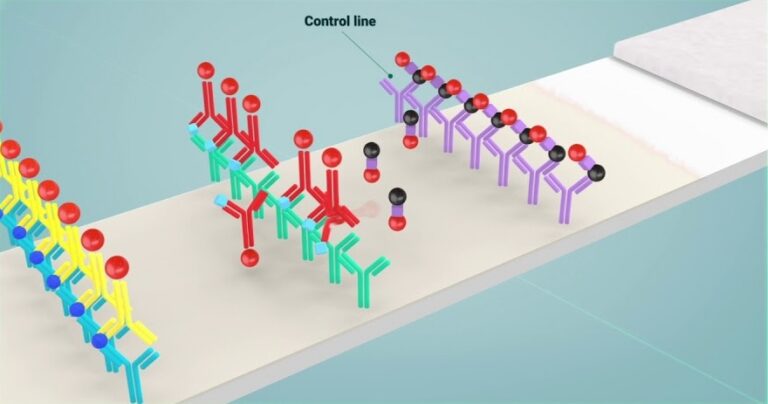
The detection particle is the most visible driver of sensitivity. Traditional colloidal gold nanoparticles produce the familiar red test line and remain the workhorse of the industry. But their optical signal does have limitations. Coloured latex particles can offer improved sensitivity while fluorescent particles and quantum dots enable detection (with a reader) at concentrations invisible to the naked eye.
Antibody selection and conjugation chemistry are equally critical. An exceptional particle paired with a mediocre antibody will still produce a mediocre test. Conjugation conditions, antibody-to-particle ratio and binding orientation directly affect capture efficiency and test line signal generation.
Nitrocellulose membrane selection influences sensitivity through flow rate and protein-binding capacity. Slower-flowing membranes give the analyte and conjugate more time to interact, improving capture efficiency at low concentrations. However, slower flow rate membranes can also increase assay time and can raise background signal if non-specific binding is not carefully controlled.
Signal Amplification: Beyond the Basic Sandwich
Nucleic acid-based amplification represents the most dramatic frontier of technical advance in lateral flow immunoassay development. Technologies coupling isothermal amplification with lateral flow readout are achieving significant improvements in sensitivity. These molecular lateral flow platforms combine the sensitivity of molecular diagnostics with the simplicity of rapid testing, challenging the traditional boundary between point-of-care and laboratory assays.
The Reader Revolution
Perhaps the most transformative shift in lateral flow sensitivity has come not from the test strip itself but from what reads it. Visual interpretation, the human eye judging whether a line is present, is inherently limited.
Dedicated lateral flow readers using reflectance, fluorescence, or chemiluminescence detection can quantify signal at levels below the visual limit. Additionally, they eliminate subjective interpretation entirely. For in vitro diagnostic (IVD) companion diagnostics and quantitative biomarker assays, reader-based detection is fundamental to achieving the performance that clinical applications demand.
Smartphone-based readers offer a middle ground: camera-based algorithms can quantify test line intensity which is important for applications which require a more portable test interpretation method, without the need for additional hardware.
Design-for-Sensitivity Requires Integration
The critical point for companies undertaking high-sensitivity lateral flow assay development, including companion diagnostic development, is that sensitivity is a system-level property, not a component-level property. Selecting a fluorescent particle does not automatically produce a highly sensitive test. Each design decision interacts with every other: particle size affects flow dynamics, flow dynamics affect capture efficiency, and particle selection determines what reader technology is required.
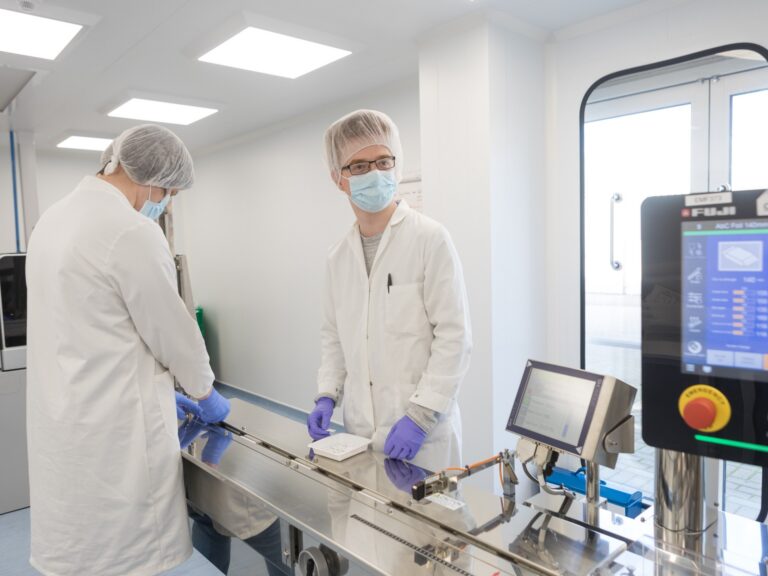
These reasons are why the choice of lateral flow development partner matters so much for sensitivity-critical applications. A CDMO (contract development and manufacturing organisation) with depth of lateral flow expertise understands these interactions and can navigate the design trade-offs systematically rather than optimising one variable at a time. The difference between a test that achieves its sensitivity target and one that falls short is usually not a single design decision, it is the accumulated effect of dozens of interdependent decisions made throughout development. This expertise also directly affects the manufacturing cost of lateral flow devices, as design efficiency and robust processes reduce the cost of goods in lateral flow contract manufacturing at scale. My colleague, Mark Jones, outlines in a previous blog the importance of Good Manufacturing Practice (GMP) as a cornerstone of lateral flow test production.
What This Means for the Market
The sensitivity revolution in lateral flow is not a theoretical future, it is happening now. Tests in development today are achieving analytical sensitivity that would have required a centralised laboratory platform five years ago. For companies developing IVD companion diagnostics, precision medicine biomarker immunoassays, or infectious disease tests targeting low-abundance pathogens, lateral flow is increasingly a viable format where previously it was not.
The companies that will realise this opportunity are those working with development partners who understand sensitivity as a design discipline. Sensitivity must be designed in from the earliest feasibility stages – particle selection, antibody selection, membrane selection, reader strategy – not bolted on after the assay architecture is locked.
Looking for Support?
Abingdon Health specialises in lateral flow assay development services, helping clients achieve their sensitivity and performance requirements through scalable, robust lateral flow assay manufacturing. As a leading IVD CDMO, Abingdon Health provides integrates lateral flow development, technical transfer services, and commercial manufacturing services from facilities in Madison, Wisconsin and York, UK. Our dual-site capability enables companies to develop and manufacture diagnostics close to their primary markets, with regulatory expertise supporting FDA 510(k), PMA, and CE-IVDR submissions. Whether reshoring existing production or establishing UK or US manufacturing for the first time, our teams provide the specialist lateral flow expertise that general-purpose CDMOs cannot match. Get in touch with Abingdon Health to explore how our integrated approach can accelerate your path to market access.