
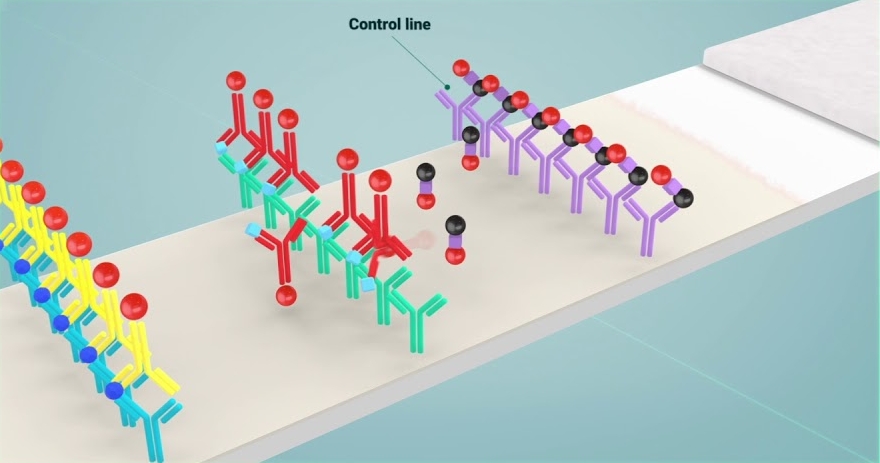
In lateral flow immunoassay (LFIA) development, particle selection is an important determinant of assay performance and a product’s overall commercial viability. While antibody choice, nitrocellulose membrane properties and manufacturing protocols are vital, the type of signal-generating particle you select – gold nanoparticles, latex beads, quantum dots or emerging alternatives – can shape the entire trajectory of your rapid diagnostic product.
In this blog, Abingdon Health’s CTO Nina Garrett outlines some key considerations.
Beyond Visualisation: Strategic Value of Particle Selection
Historically, particle selection for lateral flow test development focused on visual clarity for a qualitative test result. Today, the right material selection can transform a qualitative test into a semi-quantitative or quantitative platform; supporting demand for high sensitivity and digital result integration across many sectors including health, veterinary and environmental monitoring.
Understanding Conjugation Chemistry: The Critical Link
Conjugation chemistry refers to the process of attaching target analyte recognition reagent (typically antibodies) to the surface of signal-generating particles. Appropriate particle selection and development of robust conjugates is a key part of the development process.
Different particles and methods for conjugation of antibodies to particles should be considered at the outset of a development program. When developing the conjugation process, passive adsorption is a simpler method when compared to chemical coupling of antibodies to a particle that has a modified surface chemistry e.g. a carboxyl functionalised particle. Regardless of the selected method, development of a reproducible and scalable conjugation protocol as part of the development program is essential to ensure consistent performance of the lateral flow test.
Established and Emerging Label Technologies
With many options available, it’s essential to compare key usage criteria and characteristics, as well as usage applications of labels, when developing a diagnostic rapid test:
- Gold nanoparticles (AuNPs): are used in both qualitative and quantitative LFIAs and these particles have well-characterised optical properties, established supply chains, and scalable manufacturing methods.
- Latex microspheres: are available in a range of sizes and colours, they support multiplexing and may offer improved stability in more harsh testing environments. There are also reliable supply chains for scaled supply of these reagents.
- Quantum dots (QDs): can deliver exceptional sensitivity and are used in quantification. These particles require fluorescence detection, so are typically used in conjunction with a reader unit.
- Carbon nanoparticles: Black-coloured carbon nanomaterials offer high contrast to nitrocellulose membranes, along with excellent stability. These particles can be lower cost compared to others.
- Up-converting phosphor particles (UCPs): These rare-earth doped particles emit visible light when excited by near-infrared radiation, virtually eliminating background interference. These particles have the potential to deliver improved sensitivity over more traditional options and are used with a reader unit.
- Europium nanoparticles: These particles are widely used in lateral flow test formats in conjunction with reader units. They produce stable, scalable conjugates.
- Magnetic nanoparticles: Magnetic particles enable pre-concentration and sample clean-up prior to use directly on the lateral flow strip. This usage type can enhance sensitivity for low-abundance biomarkers in challenging matrices like environmental water samples. They can be visualised, but also used with reader units to provide a quantitative test output.
Manufacturing and Commercialisation: Scale and Supply Chain
Particle choice impacts not just technical performance, but also manufacturing scale, supply chain resilience and cost structures.
Successful selection of particles for use in lateral flow applications require systematic evaluation of:
- Consistency and scale of the starting raw material, including methods for characterisation e.g. size, mono-dispersity and functionalisation
- Performance and sensitivity requirement for the test under development
- End user needs
- Manufacturing scalability
- Reader compatibility and digital health integration requirements
- Supply chain, and stability for storage and global shipping
- Cost-effectiveness
Strategic Partnership Matters
The decision of which particle to incorporate in the development of a lateral flow test is important not just for performance, but also for the way that the end user will use the product, the scalability and overall cost of the product.
For diagnostics companies – whether in healthcare, animal health, food or environmental testing – partnering with a CDMO with expertise across multiple particles and platforms is essential for navigating technical and process development challenges.
Abingdon Health is a fully integrated CDMO and CRO with ISO13485 and ISO9001 certifications, dual UK & US development and manufacturing facilities, and decades of end-to-end lateral flow expertise. Our team supports clients at every stage, from feasibility and particle selection through conjugation optimisation to regulatory submission and commercial scale-up – delivering robust, compliant, and scalable diagnostic products.
To learn more about optimising your lateral flow assay or to discuss your next project, get in touch with a member of our team today.